
Health Economic Evaluation
What an intervention costs to achieve its result, and whether the same money would do more good elsewhere.
Health economic evaluation helps determine whether healthcare interventions deliver value relative to the resources they consume. Using data from clinical studies, real-world evidence, and decision-analytic models, our team conducts cost-effectiveness, cost-utility, cost-benefit, and budget impact analyses to assess the economic implications of medicines, medical devices, diagnostics, program, and models of care, to support evidence-informed healthcare investment and resource allocation decisions.
How we support your evaluation
Choosing the form of evaluation: Cost-effectiveness, cost-utility, cost-benefit analysis, or budget impact analysis, based on the decision context and evidence needs.
Integrating economic evaluation into study design: work alongside clinical and research teams from the planning stage to define the study perspective, time horizon, outcome measures, resource-use data, and other key parameters, ensuring that the data required for the economic evaluation are collected efficiently and appropriately.
Economic modelling: Develop decision-analytic models to estimate the long-term costs, outcomes, and value of healthcare interventions beyond the duration of a clinical study, enabling more comprehensive assessments of their impact.
Analysis and reporting: Conduct health economic analyses in accordance with established methodological standards and prepare clear, transparent reports that communicate the methods, assumptions, results, and implications for decision-makers.
Evidence synthesis for an evaluation:where the evaluation require evidence from multiple sources for robust estimates of clinical effectiveness, resource utilization, costs, and health outcomes for use in economic models and evaluations. See Systematic Review and Meta-analysis.
The steps common to every study we support — protocol methodology, analysis plan, data review, analysis datasets and the analysis itself — are described under Project Collaboration, along with reporting and publication support.
Our experience
Our HEOR team forms the nucleus of health economic evaluation expertise at SCRI. We were among the first groups in Singapore to incorporate health economic evaluation into grant applications, and the first team here to run workshops on health economic evaluation alongside clinical studies. We provide technical support and scientific leadership to help local clinical researchers build economic evaluation into their own research.
Our work in practice
Mobile Inpatient Care @ Home (MIC@Home)
MIC@Home is an alternative model of inpatient care that enables clinically suitable patients to receive hospital-level care in the comfort of their own homes rather than in a conventional hospital ward. Supported by strong clinical and health economic evidence, MIC@Home has since been integrated into routine public hospital services in Singapore.
The SCRI Health Economics and Outcomes Research (HEOR) and Biostatistics teams contributed to the evidence base underpinning this initiative through close collaboration with clinical partners from the National University Health System (NUHS) and Khoo Teck Puat Hospital in the evaluation of the Hospital-at-Home (HaH) and Medical Home (MH) programmes. The Biostatistics team supported the analysis of clinical outcomes, while the HEOR team led the health economic evaluation. Both teams contributed to grant applications, study design, interpretation of findings, and dissemination of results.
Hospital-at-Home Study
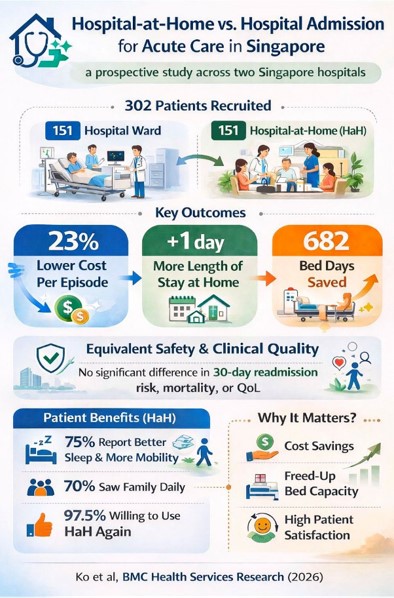
In the HaH study[1] involving 302 patients across two NUHS hospitals, patients receiving hospital-level care at home achieved significantly lower healthcare costs, with a 23% reduction in cost per episode of care and 682 hospital bed-days saved. Clinical outcomes, including 30-day readmission rates, mortality, and quality of life, were comparable to conventional inpatient care. Patient experience was highly positive, with three-quarters of participants reporting better sleep quality and mobility, 70% reporting that they were able to spend time with family members daily, and 97.5% indicating that they would choose HaH care again in the future.
Medical Home Study
Similarly, the Medical Home study[2], which involved 250 patients at Khoo Teck Puat Hospital, was the first local study to evaluate a hospital-at-home care model tailored for frail older patients in Singapore. The study demonstratedthat this care model is a value-based and cost-effective alternative for selected frail older adults. Compared with usual care, patients in the MH group achieved a positive incremental net monetary benefit of S$6,895 from a health system perspective, experienced significantly shorter lengths of stay and better caregiver experiences, while maintaining comparable clinical, functional, and patient experience outcomes.
Together, these studies demonstrate the potential of hospital-at-home models to improve healthcare efficiency, enhance patient and caregiver experiences, and support the delivery of high-quality care closer to home.
Engaging us
An economic evaluation is much stronger when it is planned with the study rather than added to it. To discuss one, contact us via email: [TO CONFIRM: contact email]
Related pages: Grant Application Collaboration · Project Collaboration · Health Technology Assessment · Real-World Evidence · Systematic Review and Meta-analysis
Selected Publications
1. Ko SQ, Rahman N, Chai JH, Goh J, Luo N, Shi L, Lai YF, Soong JTY, Chan DKW, Peh ALT, Kuan WS, Lim YW. Hospital-at-home versus hospital admission for acute care in Singapore: a prospective quasi-experimental study on cost, utilisation and clinical outcomes. BMC Health Serv Res. 2026 Jan 20;26(1):242. doi: 10.1186/s12913-025-13938-5.
2. Boh TL, Hu Y, Tan A, Chai JH, Zhu Y, Shi L, Ng YF, Ang YH. Patient-centred outcomes and cost-effectiveness of a hospital-at-home service model for older adults. Ann Acad Med Singap. 2026 Apr 10;55(4):189-198. doi: 10.47102/annals-acadmedsg.2025325.