

About Inherited Cancers Network Asia
About ICaN Asia
ICaN Asia was established in 2025 with the goal of improving health outcomes for individuals with hereditary cancers across the Asia-Pacific region. Its efforts focus on the following objectives:
1. Empower
Strengthen patients, families, and clinicians by improving access to knowledge, resources, and support systems that enable informed decision-making and better life outcomes.
2. Educate
Deliver high-quality educational programs — including webinars, symposia, and regional forums — to raise awareness, enhance professional knowledge, and advance standards of care in hereditary cancers.
3. Engage
Build a strong, multi-stakeholder regional network across Southeast Asia to foster collaboration among clinicians, researchers, patients, and policymakers, while establishing prospective cohorts to support future research and trials.
4. Enable
Develop a real-time regional data registry and centralized cancer cohort repository, analyze patient management pathways to identify care gaps, and expand access to clinical trials across the region.
5. Elevate
Generate high-quality regional data and collaborative research to inform policy, influence funding priorities, and elevate standards of hereditary cancer care across Asia-Pacific.
Globally, cancer is one of the top causes of death in people below age 70. In the year 2020, approximately 19.3 million newly diagnosed cancer cases, and 10 million cancer-related deaths were reported 1. Asia is projected to see around 11.5 million new cancer cases in 2030, according to the International Agency for Research on Cancer1. The key determinant for this is multi-factorial, but includes a rapidly aging population, environmental factors and family history. Around 10% (range 1-30%) of cancers are hereditary in nature, caused by a pathogenic variant that runs in the family2. In the past decades, enormous strides have been made to unravel the genetic basis of cancer and this knowledge has been used to develop targeted treatments for hereditary forms of cancer.
However, many health systems across the region face wide-ranging challenges such as limited accessibility, or availability of clinical trials and novel cancer drugs. Lack of access to cancer drugs has had a negative impact on patient outcomes, resulting in premature cancer deaths.
Vision
Improve health outcomes for individuals with hereditary cancers in the Asia-Pacific region
Mission
-
Improving Care Coordination: Identify and address gaps in the end-to-end patient management
-
Expanding Access to Clinical Trials: Ensure that patients in the Asia-Pacific region can access treatment and preventative clinical trials
-
Promoting Genomic Medicine Research: Facilitate pan-Asian research that spans from basic and translational studies to multi-center clinical trials
-
Empowering Patients & Raising Awareness: Engage and empower patients while increasing awareness of hereditary conditions throughout the Asia-Pacific region
Problem Areas
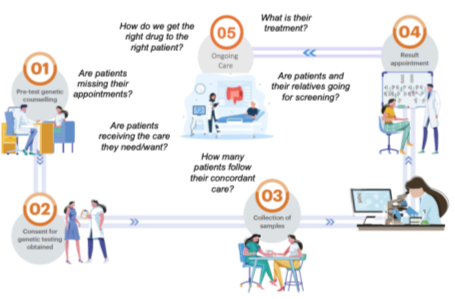
Image reference: HBOC booklet https://www.nccs.com.sg/content/dam/singhealth-web/nccs/our-specialties/pdfs/ncc-hboc-brochure.pdf
These pain points can be summarized into two key points that we aim to address:
1) Adoption and concordance
2) Lack of clinical trials in Southeast Asia.
References
-
Ferlay J, Colombet M, Soerjomataram I, Parkin DM, Pineros M, Znaor A, et al. Cancer statistics for the year 2020: An overview. Int J Cancer. 2021.
-
Nagy R, Sweet K, Eng C (2004) Highly penetrant hereditary cancer syndromes. Oncogene 23(38):6445–6470